Chapter 03 · The Word
The revolutionarywith a pen
Bismil published under three names, worked in two literary languages, translated from a third, and finished a book in a condemned cell. Almost everything he is remembered for passed through paper first.
The signatureThree names for one writer
He signed his work as Ram, as Agyat — literally “unknown” — and as Bismil. The last is an Urdu word carrying the sense of wounded, and it is the one under which he became known. The multiplicity was not affectation. A writer publishing political material in the United Provinces after 1918 had practical reasons to distribute his identity across several signatures, and a writer moving between Hindi and Urdu readerships had literary ones.
The choice of Agyat is worth pausing on. A pen-name that announces anonymity is a small joke and a serious position at once: it puts the argument in front of the author, which is exactly what a clandestine political press requires. The consequence is that attributing individual pieces to him is harder than it looks, and this website is correspondingly cautious about doing so.
Two literaturesHindi and Urdu, at the same desk
The literary situation of northern India in the 1910s and 1920s is often described as a split between a Sanskritised Hindi and a Persianised Urdu, hardening into separate communal properties. Bismil's practice cuts across that description. He learned Hindi from his father and Urdu from a maulvi in the same town in the same years, and he wrote in both. His verse draws on the Urdu ghazal — its couplet form, its conventions of the wounded lover repurposed toward political feeling — while his prose, pamphlets and translations are largely in Hindi.
This bilingualism had a political dimension that had nothing to do with sentiment. Verse in Urdu could be recited at a gathering where a Hindi pamphlet would not travel, and the reverse. A writer who could work in both had twice the reach in a province where the two publics overlapped but did not coincide.
The image
How a writer came to be pictured
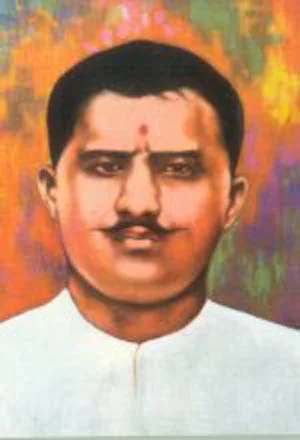
- Medium
- Painted portrait — a later artistic interpretation, not a photograph.
- Source portrait
- Follows the composition of the surviving archival photograph: same posture, same collarless kurta, same tilak.
- Date
- Not established. Presented here as an object of commemoration rather than as evidence of appearance.
Only a very small number of images of Bismil survive, and effectively all later depictions descend from a single photograph. This painted version is one of them. It has been placed on this page, rather than among the historical evidence, for a specific reason: it belongs to the history of how Bismil was remembered, not to the history of what he looked like.
The colouring is instructive. The photograph is grey, worn and small. The painting gives him warmth, a steadier gaze, and a saturated ground. Between the two lies half a century of a country deciding what its revolutionaries should look like — which is itself a subject worth studying, and one this website returns to on Legacy.
Every image on this website is shown complete. Portraits are never cropped to fit a layout, and no historical face is cut by a frame edge.
A question of attribution
The most famous verse
in the Indian freedom movement
— and the reason it is not printed on this page as his.
The couplet beginning “Sarfaroshi ki tamanna ab hamare dil mein hai” is one of the best-known lines in modern Urdu, and it is attached to Ram Prasad Bismil almost everywhere it appears. It was not written by him. It was written by a different poet who used the same pen-name.
Bismil Azimabadi
An Urdu poet of Patna — Azimabad — who composed the ghazal around 1921. It is recorded as having been recited at the Congress session at Calcutta in 1920 and published in the Urdu daily Sabah in 1921. The Indian government's own cultural repository lists the poem under his name.
Ram Prasad Bismil
Took the ghazal up, carried it through the Kakori years and the trial, and made it inseparable from the revolutionary movement. Popularising a poem is a real historical act — it is simply a different act from writing one, and the distinction is worth keeping.
Why the confusion is genuinely difficult. Both men used the takhallus “Bismil”. A pen-name is not a surname, and it was entirely ordinary for several poets of the period to share one. Two writers, one signature, one enormously popular poem, and a movement that carried it far beyond either of them — the result was inevitable, and it has been repeated in print, in film and in school textbooks for a century.
The bibliography
What he actually wrote and published
Poetry, translation, polemic and memoir — produced in about a decade, much of it while he was in hiding.
- Deshvasiyon ke Naam Sandesh “A Message to My Countrymen” — a political pamphlet, published and circulated in the United Provinces. Its distribution formed part of the Mainpuri Conspiracy proceedings. 1918
- Man Ki Lahar A collection of his own verse, issued during the underground years through the Sushilmala series of cheap popular booklets. c.1919
- Bolshevikon Ki Kartoot Translated from Bengali. Part of a wider effort to bring accounts of European revolutionary movements to Hindi readers who had no other route to them. c.1919
- Yogik Sadhan Translated from Bengali — a work on yogic practice, and a reminder that his reading was not confined to politics. c.1919
- Catherine, athva Swadhinta Ki Devi An adaptation from an English source, treating the life of a European woman revolutionary. Circulated as inexpensive popular reading. c.1919
- The autobiography Written in the condemned cell at Gorakhpur and finished shortly before his execution. Smuggled out in instalments and published by Ganesh Shankar Vidyarthi from the Pratap Press, Cawnpore, under the cover title Kakori ke Shaheed. 1927–28
- Kranti Geetanjali A collection published after his death. It was proscribed by the colonial government in 1931 — four years after the author had been executed. 1929
On the texts themselves. This website discusses Bismil's writing rather than reproducing it at length. Editions of the underground booklets are scarce, translations vary, and several titles circulate in versions that cannot be checked against an original. Where a text cannot be verified, it is described here and not quoted.
On the last morning
The lines he is recorded as reciting
Malik teri raza rahe aur tu hi tu rahe,
Baqi na main rahun na meri aarzu rahe.
Lord, let your will remain, and let you alone remain;
let neither I remain, nor any desire of mine.
What is documented and what is not. Accounts of 19 December 1927 record Bismil reciting this couplet at Gorakhpur. What those accounts do not establish is that he composed it; a devotional couplet recited at such a moment may as easily have been drawn from what he had read. It is given here as what he said, not as what he wrote — a distinction this website applies throughout.
Contested attributions
The song “Mera rang de basanti chola” is widely credited to Bismil, and equally widely credited to others — including, again, Bismil Azimabadi. Some accounts place its composition among the Kakori prisoners in 1927. The authorship is genuinely unsettled in the published literature, and this website therefore records the dispute rather than choosing a side. Popular internet quotation collections attribute a great deal more to Bismil than any source will support; none of that material appears here.
Analysis
Poetry as resistance
Why verse did political work in colonial India that speeches, newspapers and parties could not do.
01
It could not be seized
A press could be raided and a pamphlet confiscated. A couplet held in a hundred memories could not be. Metre and rhyme are storage technologies, and under censorship that is a political property, not merely an aesthetic one.
02
It crossed literacy
Literacy in the United Provinces of the 1920s was low. A poem recited or sung reached the people a printed argument could not, and reached them in a form they could repeat to others without owning a copy of anything.
03
It made a collective “we”
Political verse of this period habitually speaks in the first person plural. Sung together, it produces the thing it describes: an audience becomes, for the length of the recitation, the group the poem addresses.
04
It borrowed an existing emotional grammar
The Urdu ghazal already had a fully developed vocabulary for longing, wounding and sacrifice in love. Nationalist poets redirected that vocabulary toward the country. The feeling was familiar; only its object had changed.
05
It outlived its authors
Poems associated with the revolutionaries were sung at meetings for decades afterwards, entered school readers, and were set to music for cinema. The verse became the principal vehicle through which most Indians ever encountered these men at all.
A limit on this argument. It does not follow that every poem written by a revolutionary was composed for a political purpose, and the claim should not be made. Writers write for many reasons. What the record supports is that verse functioned politically in this period — not that every line was intended as an instrument.
The last bookA memoir written under sentence of death
Of everything Bismil wrote, the autobiography is the most consequential. He composed it in the condemned cell at Gorakhpur during 1927 and finished it days before his execution. The manuscript left the jail in instalments and was published by the editor and nationalist Ganesh Shankar Vidyarthi from the Pratap Press at Cawnpore, under a cover title that concealed what it was.
It is the primary source for almost everything we know about his childhood, his reading, his account of the Mainpuri years, and his own explanation of the decisions that led to Kakori. It is also, plainly, a text written to be read after his death by an audience he wished to persuade. Both things are true at once, and a serious reading holds them together.
The colonial state understood its importance immediately. The Criminal Investigation Department produced its own translation and circulated it as a confidential document for official and police use across the country — an unusual compliment to pay to a book, and a reasonably good measure of what the administration thought a dead man's prose could still do.