Chapter 05 · Sunday, 9 August 1925

Kakori1925

A village stop on the Lucknow line, a passenger train carrying government cash, ten members of an organisation that had almost no money, and a prosecution that ran for eighteen months and ended four lives.

8 Down · Shahjahanpur → Lucknow Halted between Kakori and Alamnagar, about 16 km short of Lucknow

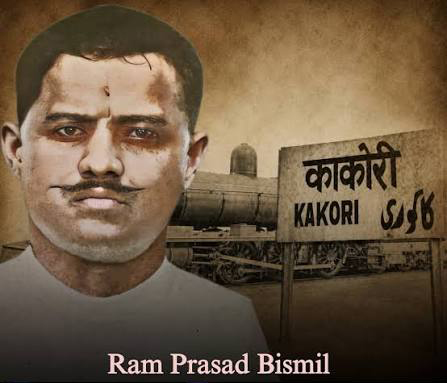
Sepia-toned commemorative illustration combining a portrait of Ram Prasad Bismil with a steam locomotive and a bilingual Kakori railway station signboard reading काकोरी and KAKORI.
What this is
A modern commemorative composition, not a photograph of the event. It combines the surviving portrait of Bismil with a steam locomotive and a Kakori station signboard.
Why it is shown
No photographs of 9 August 1925 exist. This image records how the event is pictured in public memory — itself part of the history set out below.
Signboard
Reads “Kakori” in Devanagari, Roman and Urdu script — the trilingual convention of railway signage in the United Provinces.

The context

Why it happened

By the middle of 1925 the Hindustan Republican Association had a constitution, a printed manifesto, a scatter of members across the United Provinces and Bengal, and no money. Everything it proposed to do — print, correspond, move members, support the dependants of those arrested — required funds that a proscribed organisation could not raise openly.

The association's answer had already been tried elsewhere in the revolutionary tradition and had failed badly: taking money from private individuals. Such actions were dangerous, unpopular, and difficult to reconcile with the organisation's own claim to be acting for the country rather than against its people.

The reasoning that produced the Kakori action followed from that difficulty. Money carried by the railways on government account was, in the participants' argument, revenue already taken from Indians by a state they did not recognise; taking it back was not theft from the public but recovery from the treasury. It is an argument that can be stated plainly and examined on its merits — and it does not survive contact with what actually happened on the train.

The line

The 8 Down, on a Sunday afternoon

  1. Shahjahanpur

    Where the train's journey and the organisation's district base coincided. Bismil, Ashfaqulla Khan and Roshan Singh all belonged to this district.

  2. Kakori

    A small station outside Lucknow. The train was stopped on the section beyond it. The name of the village became the name of the case, and afterwards of a chapter of Indian history.

  3. Lucknow

    The intended destination, and subsequently the seat of the Special Sessions Court in which the accused were tried for eighteen months.

On the account that follows. The sequence below is given at the level of what happened and what followed. It contains no operational detail — no description of methods, preparation or equipment. This is a deliberate editorial limit, appropriate to a site intended for students and general readers.

The day

9 August 1925, in sequence

Ten members of the association travelled on the 8 Down passenger train

The train ran from Shahjahanpur towards Lucknow. Those involved were Ram Prasad Bismil, Ashfaqulla Khan, Rajendra Nath Lahiri, Chandrashekhar Azad, Sachindra Bakshi, Keshab Chakravarty, Manmath Nath Gupta, Mukundi Lal, Murari Lal and Banwari Lal.

The train was stopped on the section beyond Kakori station

The location was rural, a short distance short of Lucknow. The target was the guard's cash chest, which held money being remitted on government account.

A passenger was killed

A shot fired by Manmath Nath Gupta struck a passenger named Ahmad Ali, a lawyer, who died. Contemporary and later accounts agree that this was not intended. It was nonetheless a death, and it transformed the legal character of what had occurred: the prosecution that followed was for murder as well as for conspiracy and robbery.

The sum taken was small

Estimates in the sources differ. The figure most often given is around ₹8,000; a more precise figure of ₹4,679, one anna and six pies also appears in accounts of the case. By any measure it was a modest amount, entirely disproportionate to the consequences that followed.

The investigation was rapid and thorough

The killing of a passenger on a public train guaranteed the fullest response the colonial police could mount. Within weeks the investigation had traced the organisation across the United Provinces and into Bengal. Bismil was arrested on 26 September 1925.

Around forty people were taken into custody

Arrests were made across northern India, extending well beyond those present on the train to the wider membership. Chandrashekhar Azad, Keshab Chakravarty and Murari Lal were never captured.

The record in figures

Documented numbers only

10

Members present at Kakori

1

Passenger killed — Ahmad Ali

c.40

Arrested across northern India

18

Months of legal proceedings

4

Death sentences carried out

3

Participants never captured

Figures are drawn from published accounts of the case. Where sources disagree — as they do on the sum taken — the disagreement is stated rather than resolved by picking a number.

The AftermathUnited Provinces1925–1927

What a small action set in motion

The immediate consequence of Kakori was the destruction of the organisation that had carried it out. Within a year the Hindustan Republican Association had lost most of its first-rank leadership to arrest, and the prosecution reached members who had taken no part in the events on the train at all.

The second consequence was public. The Kakori Conspiracy Case became one of the most closely followed trials of the decade. It ran for eighteen months in a Lucknow courtroom, and the accused used it — as political defendants have always used trials — as a platform.

The third consequence was political, and it cut across party lines. When death sentences were confirmed, senior nationalist figures who disagreed entirely with the revolutionaries' methods petitioned for commutation. Motilal Nehru, Madan Mohan Malaviya, Muhammad Ali Jinnah, Lala Lajpat Rai, Jawaharlal Nehru and Ganesh Shankar Vidyarthi were among those who supported the appeals.

A mercy petition carrying seventy-eight signatures from members of the Central Legislature was rejected by the Viceroy, Lord Irwin, on 9 September 1927. A further appeal to the Privy Council in London failed the same month.

The fourth consequence was the longest-lasting. The younger members who escaped prosecution — Chandrashekhar Azad above all — reconstituted the organisation in 1928 as the Hindustan Socialist Republican Association, with a programme that had moved decisively toward socialism. The line of activity that produced Bhagat Singh and the events of 1929 runs directly out of Kakori.

The fifth was cultural. The executions of December 1927 produced a body of mourning literature, songs and remembrance that carried these men into the popular imagination far more effectively than anything they had done while alive.
Historical significance

Why the name of a village entered Indian history

Measured by its own objectives, the Kakori action failed completely. The sum obtained was small, the organisation it was meant to fund was destroyed within a year, and an uninvolved passenger died. Judged as an operation, there is very little to be said for it.

Its historical significance lies almost entirely in what followed. The trial gave the revolutionary argument an extended public hearing it could never have obtained otherwise. The response of mainstream nationalist leaders demonstrated that the question of how India should be freed was contested inside the movement, not only between the movement and the state. And the executions provided the movement with exactly what a state should be most careful about supplying: a small number of young, articulate, well-documented dead.

A note on what the event is called

The episode has been described in English as the Kakori train robbery, the Kakori conspiracy and the Kakori case. In August 2021 the Government of Uttar Pradesh directed that official usage should be “Kakori Train Action”, on the ground that the earlier Hindi term kand carried a derogatory sense. Each name embeds a judgment: robbery is the language of the prosecution, action the language of commemoration. This website uses the neutral phrasing “the Kakori action” in its own voice, and uses Kakori Conspiracy Case where it refers specifically to the legal proceedings, because that is what those proceedings were formally called.

The trial and the final days