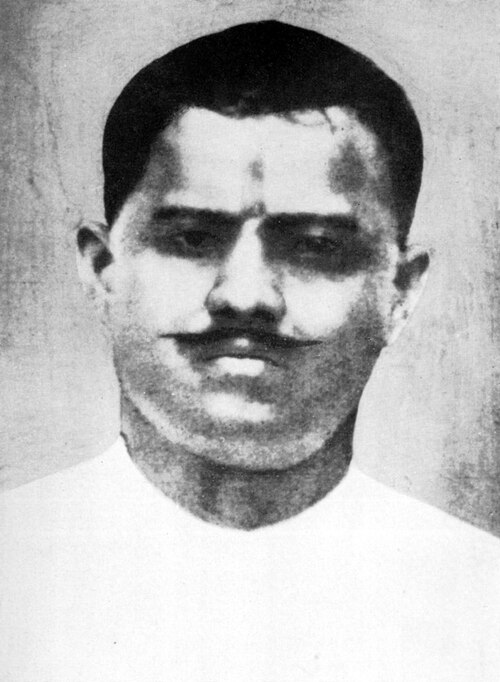
Archival black-and-white photographic portrait of Ram Prasad Bismil as a young man, wearing a white collarless kurta, a tilak mark on his forehead.
The archival portrait The most widely reproduced photograph of Bismil, shown complete and uncropped.

Shahjahanpur · Kakori · Gorakhpur

RamPrasadBismil

Poet Revolutionary Freedom Fighter

1897 1927 Thirty years

He was hanged at thirty. He left behind four volumes of verse, a stack of banned translations, and an autobiography finished days before the end.

The word came first

A note on the famous verse. The couplet “Sarfaroshi ki tamanna ab hamare dil mein hai” is almost universally attached to Ram Prasad Bismil. It was in fact written by a different poet who used the same pen-name — Bismil Azimabadi of Patna. Ram Prasad Bismil carried it into history. This website keeps the two men apart, and explains why the confusion happened, on The Poet.

A life in three acts

One man, read three ways

Bismil is usually remembered for the last of these. He spent far more of his life inside the first.

01

The Poet

Hindi and Urdu verse, translation, polemic, memoir Enter the chapter

He wrote under three names — Ram, Agyat and Bismil — and worked across two literary traditions at once. Translation, pamphlet, ghazal and autobiography were not a sideline to his politics. They were how his politics was made and carried.

Read about Ram Prasad Bismil as a poet

02

The Revolutionary

Mainpuri, the Hindustan Republican Association, Kakori Enter the chapter

After Gandhi suspended the Non-Cooperation Movement in 1922, a section of young nationalists in the United Provinces concluded that constitutional and mass-movement politics had reached a dead end. Bismil helped organise what they built instead.

Read about Ram Prasad Bismil the revolutionary

03

The Martyr

The Kakori Conspiracy Case and the memory that followed Enter the chapter

The eighteen-month trial that followed Kakori turned a small clandestine organisation into a national argument. What happened after 19 December 1927 — the mourning, the retellings, the myth-making — became a second history of its own.

Read about the trial and final days

The chronology

Thirty years, set in order

Where the record is firm, the date is given. Where accounts differ, the entry says so.

1897Shahjahanpur

Born, 11 June

Born in Shahjahanpur in the North-Western Provinces — today's Uttar Pradesh — to Murlidhar and Moolmati. The family had come to Shahjahanpur from the Tomarghar country of the Chambal, in the princely state of Gwalior.

1913Arya Samaj

The Arya Samaj and the first political shock

As a schoolboy he joined the Arya Samaj at Shahjahanpur and read Dayanand Saraswati's Satyarth Prakash. There he met the ascetic Swami Somdev. Reading of the death sentence passed on the nationalist Bhai Parmanand, he wrote a Hindi poem, Mera Janm, and showed it to Somdev.

Detailed on Early Life

1918Mainpuri

The Mainpuri Conspiracy

With Genda Lal Dixit he took part in an early revolutionary grouping in the United Provinces. In January 1918 he published the pamphlet Deshvasiyon ke Naam Sandesh — “A Message to My Countrymen” — and circulated proscribed literature at the Delhi Congress. He evaded arrest and was declared an absconder in November 1919.

1919Underground

The writing years

Moving between villages under assumed names, he wrote and translated: the poetry collection Man Ki Lahar, the Bengali translations Bolshevikon Ki Kartoot and Yogik Sadhan, and Catherine, athva Swadhinta Ki Devi. Several were later proscribed by the Government.

1920Amnesty

Released, and drawn into the Congress

Freed under the general amnesty of February 1920, he returned openly to Shahjahanpur, took up work in the silk trade, and joined the Indian National Congress. He attended the Ahmedabad session of 1921, where he worked for the resolution on complete independence.

1922The rupture

After Chauri Chaura

When Gandhi called off the Non-Cooperation Movement in February 1922 following the violence at Chauri Chaura, Bismil was among the younger nationalists who broke with the Congress leadership. The decision is the hinge of his political life.

1924Kanpur

The Hindustan Republican Association

A constitution drafted at Allahabad the previous year with Sachindra Nath Sanyal and Jadugopal Mukherjee was settled at a meeting in Cawnpore on 3 October 1924. Bismil became district organiser for Shahjahanpur, then provincial organiser for the United Provinces.

Detailed on The Revolutionary

1925The manifesto

“The Revolutionary”

In the first days of January 1925 the association issued a four-page printed manifesto titled The Revolutionary, distributed across the United Provinces. It set out the aim of a federal republic of the United States of India founded on universal suffrage.

19259 August

Kakori

Ten members of the association stopped the 8 Down passenger train near Kakori, outside Lucknow, and took the government cash it was carrying. A passenger, Ahmad Ali, was killed by a stray shot. Bismil was arrested on 26 September 1925; some forty people were taken into custody across northern India.

Detailed on Kakori

1926Lucknow

The Kakori Conspiracy Case

The trial opened before the Special Sessions Judge A. Hamilton at Lucknow in May 1926 and ran for some eighteen months. The accused were defended by counsel including Govind Ballabh Pant, Mohanlal Saksena and Chandra Bhanu Gupta.

19276 April

Judgment, appeal, and refusal

Judgment was delivered on 6 April 1927. Appeals to the Chief Court of Oudh were dismissed on 22 August 1927. A mercy petition signed by seventy-eight members of the Central Legislature was rejected by the Viceroy, Lord Irwin, on 9 September 1927; an appeal to the Privy Council failed that same month.

192719 December

Gorakhpur

Ram Prasad Bismil was hanged at Gorakhpur Jail. Ashfaqulla Khan was hanged the same day at Faizabad and Roshan Singh at Naini, Allahabad; Rajendra Nath Lahiri had been hanged at Gonda two days earlier. Bismil's body was taken through Gorakhpur and cremated on the bank of the Rapti, at the place the public afterwards called Rajghat.

Detailed on Trial & Final Days

1928Afterwards

The autobiography escapes the jail

The account of his life that he wrote in the condemned cell was carried out of Gorakhpur page by page and published by Ganesh Shankar Vidyarthi from the Pratap Press at Cawnpore under the cover title Kakori ke Shaheed. The colonial Criminal Investigation Department circulated its own translation as a confidential document for police use.

Detailed on Legacy

Two dimensions of one life

The word

Literaturethe making of a public feeling

Bismil's writing did the work that mass media could not do in the United Provinces of the 1920s. Verse could be memorised, sung in a crowd, and repeated where a printed sheet would be seized. Translation put Bengali and European revolutionary writing into Hindi and Urdu for readers who had no other access to it. Pamphlets argued a case.

  • 01Wrote in both Hindi and Urdu, and moved between the two literary worlds
  • 02Published under the pen-names Ram, Agyat and Bismil
  • 03Translated from Bengali and adapted from English sources
  • 04Several titles were proscribed by the colonial government

The Poet

The fire

Organisationthe making of a political machine

The other half of the record is administrative rather than romantic: constitutions drafted, districts assigned, a manifesto printed and distributed, money raised and accounted for. Bismil's roles in the Hindustan Republican Association were organisational, and the Kakori action itself was undertaken to fund an organisation that had almost no money.

  • 01Constitution drafted at Allahabad, 1923; settled at Cawnpore, 3 October 1924
  • 02District organiser, Shahjahanpur; later provincial organiser, United Provinces
  • 03The manifesto The Revolutionary, printed January 1925
  • 04Ten men at Kakori; some forty arrested across northern India

The Revolutionary

Reading only one of these columns produces a distorted figure — either a sentimental poet who happened to be executed, or an armed conspirator with no interior life. The historical Bismil is the person in whom both columns are the same activity.

In closing

A life that became a memory of freedom

Ram Prasad Bismil died before he was thirty-one, in a movement that would not win Indian independence for another twenty years. What survives is not a victory but a body of writing, a documented record of political organisation, and a memory that later generations kept returning to and remaking. This website follows that life in sequence, and marks the places where evidence ends and remembrance begins.

Explore His Story The Archive